 Add to Chrome
 Add to Firefox
 Add to Edge
PARE: Pruning and Adaptive Routing for Efficient Video Generation
May 26, 2026
Video Diffusion Transformers (DiTs) generate high-quality videos but demand substantial compute due to wide blocks, deep architectures, and iterative sampling. Recent methods reduce cost by compressing width, depth, or sampling steps, but typically commit to a fixed architecture that cannot adapt to individual inputs or denoising stages. We propose PARE (Pruning and Adaptive Routing for Efficient video generation), which jointly compresses width and depth with structure-aware pruning and input-adaptive routing. For width, we observe that attention heads specialize into spatial and temporal roles, and design importance scoring that accounts for this distinction to prevent motion-critical temporal heads from being pruned prematurely. For depth, we train a lightweight router conditioned on denoising timestep and visual content to dynamically select which blocks to execute at each step, enabling per-input compute adaptation rather than static block removal. A progressive pipeline first recovers width-pruned quality via distillation, then jointly optimizes the student and router to decouple the two learning objectives. Experiments on Wan2.1-14B for both image-to-video and text-to-video generation show that PARE substantially reduces per-step computation while preserving quality across VBench dimensions, and composes with step distillation for further acceleration.

BEAT: Rhythm-Elastic Alignment for Agentic Music-guided Movie Trailer Generation
May 26, 2026Automatic movie trailer generation must select shots from a full-length film and synchronize them with background music. Existing methods either relegate music alignment to post-processing or enforce rigid one-to-one shot-music mappings, overlooking that professional editing rhythm is elastic: rapid cuts accompany high-energy passages while sustained shots span quieter bars. We introduce BEAT, a framework that addresses this gap with two core components: MuVA, a compact music-visual alignment encoder trained with Sinkhorn-regularized two-stage learning, and Bar-DP, an energy-adaptive dynamic programming algorithm that produces elastic many-to-one alignments following musical dynamics. These components are integrated into a five-phase agentic pipeline that grounds the core alignment in learned cross-modal features while coordinating higher-level creative decisions through structured text signals. To support comprehensive evaluation, we also introduce TrailerArena, a benchmark with 20+ metrics across four complementary dimensions. On TrailerArena, BEAT achieves state-of-the-art performance across shot selection, ordering, and perceptual quality, while producing fully composed trailers end-to-end.
LamPO: A Lambda Style Policy Optimization for Reasoning Language Models
May 20, 2026Reinforcement learning with verifiable rewards (RLVR) has become an effective paradigm for improving reasoning language models on tasks such as mathematics, coding, and scientific question answering. However, widely used group-relative objectives, such as GRPO, summarize each sampled group with scalar statistics and therefore discard fine-grained relational information among candidate responses. This weakens credit assignment under sparse outcome rewards, especially when multiple generated solutions differ only subtly in reasoning quality. We propose \textbf{LamPO}, a \textbf{Lambda-Style Policy Optimization} method that replaces scalar group advantages with a \emph{Pairwise Decomposed Advantage}. LamPO aggregates pairwise reward gaps within each response group and modulates each comparison by a confidence-aware weight computed from sequence log-probability differences, while retaining the critic-free and clipped-update structure of PPO-style optimization. When reference solutions are available, we further add a lightweight ROUGE-L-based dense auxiliary reward to reduce reward sparsity. Experiments on AIME24, AIME25, MATH-500, and GPQA-Diamond with Qwen3-1.7B, Qwen3-4B, and Phi-4-mini show that LamPO consistently improves over GRPO and recent RLVR variants, with more stable training dynamics and better sample efficiency.
LambdaPO: A Lambda Style Policy Optimization for Reasoning Language Models
May 19, 2026Group Relative Policy Optimization(GRPO) has become a cornerstone of modern reinforcement learning alignment, prized for its efficacy in foregoing an explicit value-critic by leveraging reward normalization across sampled trajectory cohorts. However, the method's reliance on a monolithic statistical baseline, such as the group mean, collapses the relational topology of the trajectory space into a single scalar, thereby erasing the fine-grained preference information essential for navigating complex, rank-sensitive reward landscapes. To address this issue, we introduce a novel framework, Lambda Policy Optimization (LambdaPO), that addresses this information-theoretic bottleneck by re-conceptualizing advantage estimation from a scalar value to a decomposed, pairwise preference structure. Specifically, the advantage for any given trajectory is formulated as the integrated sum of reward differentials against all peers in its cohort, where each pairwise comparison is dynamically attenuated by the policy's own probabilistic confidence in the established preference. To further mitigate the sparsity of binary outcome supervision, we augment the objective with a semantic density reward, derived from the precision-recall alignment between generated reasoning traces and ground-truth solutions. As a result, our method can mine more fine-grained optimization signals from a group of rollouts, guiding the LLM to a better optima. Experimental results across challenging math reasoning and question-answering tasks demonstrates that LambdaPO improves performance compared to the baseline methods.
Uni-Animator: Towards Unified Visual Colorization
Feb 26, 2026We propose Uni-Animator, a novel Diffusion Transformer (DiT)-based framework for unified image and video sketch colorization. Existing sketch colorization methods struggle to unify image and video tasks, suffering from imprecise color transfer with single or multiple references, inadequate preservation of high-frequency physical details, and compromised temporal coherence with motion artifacts in large-motion scenes. To tackle imprecise color transfer, we introduce visual reference enhancement via instance patch embedding, enabling precise alignment and fusion of reference color information. To resolve insufficient physical detail preservation, we design physical detail reinforcement using physical features that effectively capture and retain high-frequency textures. To mitigate motion-induced temporal inconsistency, we propose sketch-based dynamic RoPE encoding that adaptively models motion-aware spatial-temporal dependencies. Extensive experimental results demonstrate that Uni-Animator achieves competitive performance on both image and video sketch colorization, matching that of task-specific methods while unlocking unified cross-domain capabilities with high detail fidelity and robust temporal consistency.
ShotDirector: Directorially Controllable Multi-Shot Video Generation with Cinematographic Transitions
Dec 11, 2025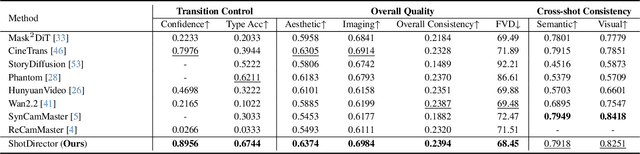
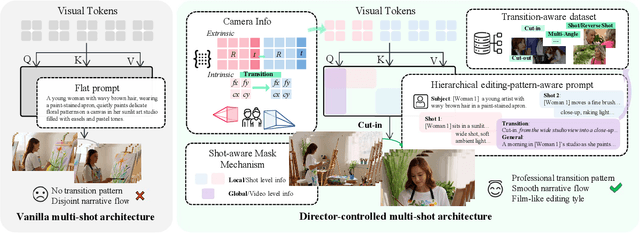

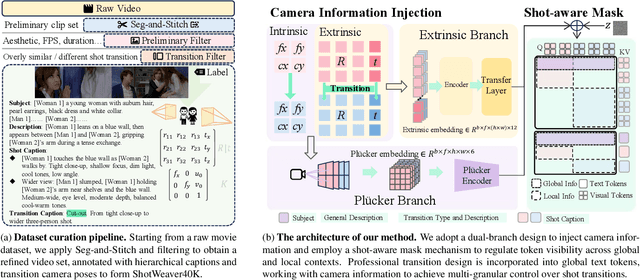
Shot transitions play a pivotal role in multi-shot video generation, as they determine the overall narrative expression and the directorial design of visual storytelling. However, recent progress has primarily focused on low-level visual consistency across shots, neglecting how transitions are designed and how cinematographic language contributes to coherent narrative expression. This often leads to mere sequential shot changes without intentional film-editing patterns. To address this limitation, we propose ShotDirector, an efficient framework that integrates parameter-level camera control and hierarchical editing-pattern-aware prompting. Specifically, we adopt a camera control module that incorporates 6-DoF poses and intrinsic settings to enable precise camera information injection. In addition, a shot-aware mask mechanism is employed to introduce hierarchical prompts aware of professional editing patterns, allowing fine-grained control over shot content. Through this design, our framework effectively combines parameter-level conditions with high-level semantic guidance, achieving film-like controllable shot transitions. To facilitate training and evaluation, we construct ShotWeaver40K, a dataset that captures the priors of film-like editing patterns, and develop a set of evaluation metrics for controllable multi-shot video generation. Extensive experiments demonstrate the effectiveness of our framework.
LIA-X: Interpretable Latent Portrait Animator
Aug 13, 2025We introduce LIA-X, a novel interpretable portrait animator designed to transfer facial dynamics from a driving video to a source portrait with fine-grained control. LIA-X is an autoencoder that models motion transfer as a linear navigation of motion codes in latent space. Crucially, it incorporates a novel Sparse Motion Dictionary that enables the model to disentangle facial dynamics into interpretable factors. Deviating from previous 'warp-render' approaches, the interpretability of the Sparse Motion Dictionary allows LIA-X to support a highly controllable 'edit-warp-render' strategy, enabling precise manipulation of fine-grained facial semantics in the source portrait. This helps to narrow initial differences with the driving video in terms of pose and expression. Moreover, we demonstrate the scalability of LIA-X by successfully training a large-scale model with approximately 1 billion parameters on extensive datasets. Experimental results show that our proposed method outperforms previous approaches in both self-reenactment and cross-reenactment tasks across several benchmarks. Additionally, the interpretable and controllable nature of LIA-X supports practical applications such as fine-grained, user-guided image and video editing, as well as 3D-aware portrait video manipulation.
Consistent and Controllable Image Animation with Motion Linear Diffusion Transformers
Aug 10, 2025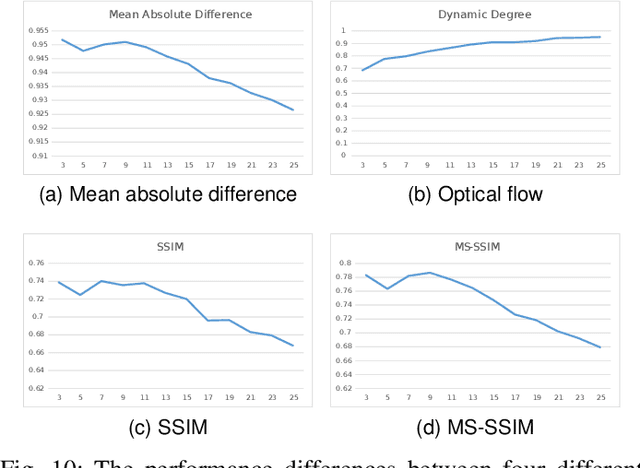

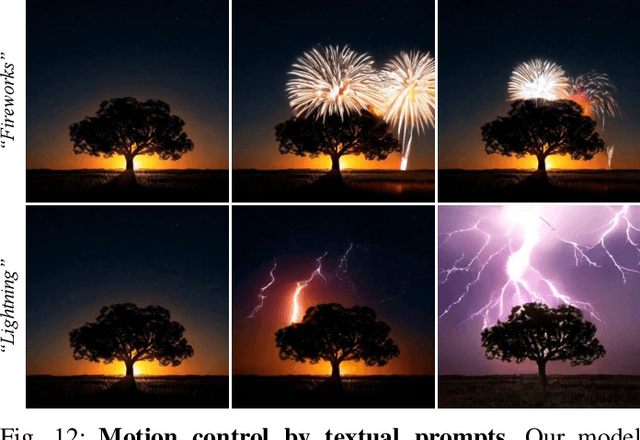
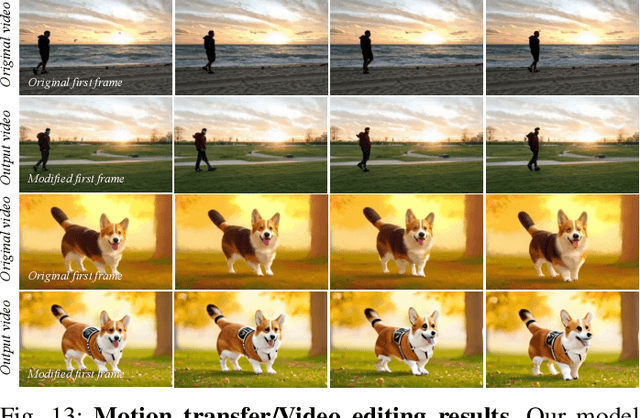
Image animation has seen significant progress, driven by the powerful generative capabilities of diffusion models. However, maintaining appearance consistency with static input images and mitigating abrupt motion transitions in generated animations remain persistent challenges. While text-to-video (T2V) generation has demonstrated impressive performance with diffusion transformer models, the image animation field still largely relies on U-Net-based diffusion models, which lag behind the latest T2V approaches. Moreover, the quadratic complexity of vanilla self-attention mechanisms in Transformers imposes heavy computational demands, making image animation particularly resource-intensive. To address these issues, we propose MiraMo, a framework designed to enhance efficiency, appearance consistency, and motion smoothness in image animation. Specifically, MiraMo introduces three key elements: (1) A foundational text-to-video architecture replacing vanilla self-attention with efficient linear attention to reduce computational overhead while preserving generation quality; (2) A novel motion residual learning paradigm that focuses on modeling motion dynamics rather than directly predicting frames, improving temporal consistency; and (3) A DCT-based noise refinement strategy during inference to suppress sudden motion artifacts, complemented by a dynamics control module to balance motion smoothness and expressiveness. Extensive experiments against state-of-the-art methods validate the superiority of MiraMo in generating consistent, smooth, and controllable animations with accelerated inference speed. Additionally, we demonstrate the versatility of MiraMo through applications in motion transfer and video editing tasks.
Self-Improvement for Audio Large Language Model using Unlabeled Speech
Jul 27, 2025Recent audio LLMs have emerged rapidly, demonstrating strong generalization across various speech tasks. However, given the inherent complexity of speech signals, these models inevitably suffer from performance degradation in specific target domains. To address this, we focus on enhancing audio LLMs in target domains without any labeled data. We propose a self-improvement method called SI-SDA, leveraging the information embedded in large-model decoding to evaluate the quality of generated pseudo labels and then perform domain adaptation based on reinforcement learning optimization. Experimental results show that our method consistently and significantly improves audio LLM performance, outperforming existing baselines in WER and BLEU across multiple public datasets of automatic speech recognition (ASR), spoken question-answering (SQA), and speech-to-text translation (S2TT). Furthermore, our approach exhibits high data efficiency, underscoring its potential for real-world deployment.
GenHOI: Generalizing Text-driven 4D Human-Object Interaction Synthesis for Unseen Objects
Jun 18, 2025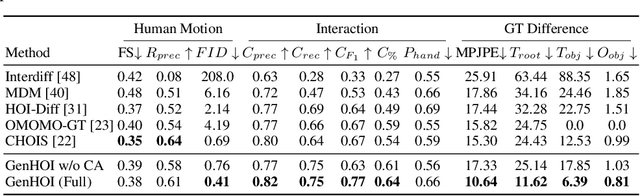
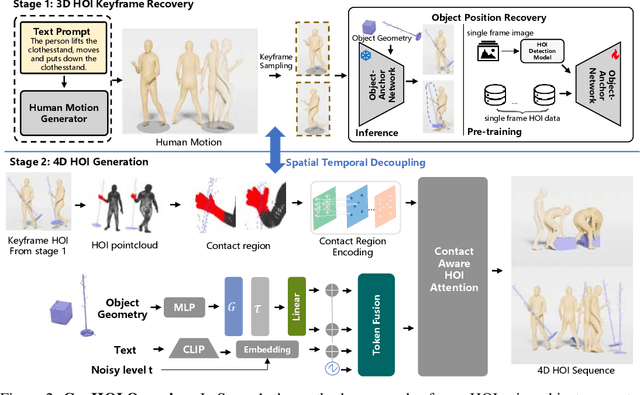
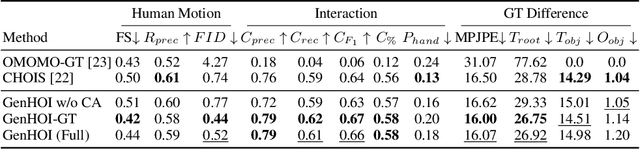
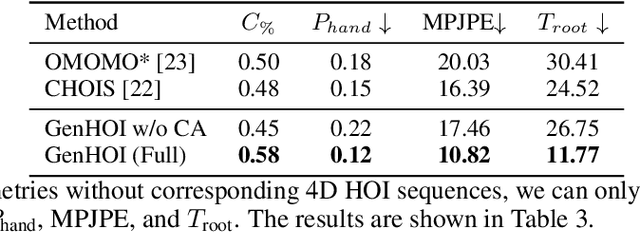
While diffusion models and large-scale motion datasets have advanced text-driven human motion synthesis, extending these advances to 4D human-object interaction (HOI) remains challenging, mainly due to the limited availability of large-scale 4D HOI datasets. In our study, we introduce GenHOI, a novel two-stage framework aimed at achieving two key objectives: 1) generalization to unseen objects and 2) the synthesis of high-fidelity 4D HOI sequences. In the initial stage of our framework, we employ an Object-AnchorNet to reconstruct sparse 3D HOI keyframes for unseen objects, learning solely from 3D HOI datasets, thereby mitigating the dependence on large-scale 4D HOI datasets. Subsequently, we introduce a Contact-Aware Diffusion Model (ContactDM) in the second stage to seamlessly interpolate sparse 3D HOI keyframes into densely temporally coherent 4D HOI sequences. To enhance the quality of generated 4D HOI sequences, we propose a novel Contact-Aware Encoder within ContactDM to extract human-object contact patterns and a novel Contact-Aware HOI Attention to effectively integrate the contact signals into diffusion models. Experimental results show that we achieve state-of-the-art results on the publicly available OMOMO and 3D-FUTURE datasets, demonstrating strong generalization abilities to unseen objects, while enabling high-fidelity 4D HOI generation.